

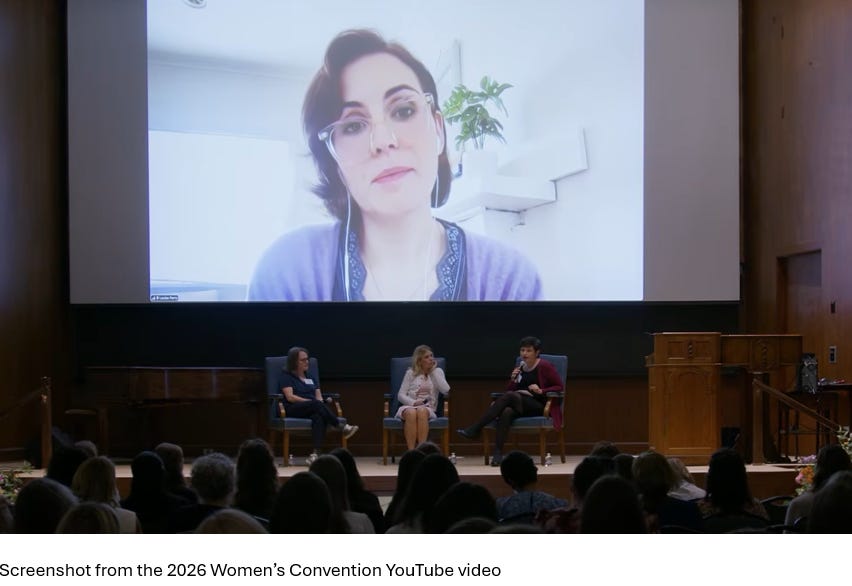
This week I watched a YouTube video from the 2026 Women’s Convention: A Declaration of Interdependence organized by women’s groups in Rochester, New York. The video featured a panel of three women discussing a question put by the editor of Fairer Disputations, Serena Sigillito:
“Could there ever be a moment where we wouldn’t need to be gathering together anymore? If it was not the attainment of legal rights, if it was not fighting employment discrimination, if it was not gaining the right to legal abortion, is there some state in which we could look around and say we have abolished the things that are keeping women down, we have achieved equality?”
I was impressed by the high calibre of thoughtful analysis put forward by author Louise Perry, former UK politician Miriam Cates, and Catholic theologian Andrea Franks. All three argued women’s advocacy would be perpetually necessary. Perry answered the question with reference to what she called the differing male and female psychologies, Cates with regard to human child development realities, and Franks with regard to sin, although she called it “disordered desire” in an excellent renaming that invokes both psychology and Buddhist wisdom.
But what came to me slowly over the course of the discussion was what was unspoken in all their visions of the world they were critiquing. All of them spoke as if the environment we all live in is the natural environment, one untainted by male “sin”, with a political/economic timeframe that ignores childhood and is “disabling” (to use Perry’s term) to women because it was created by men and for men, and was based on male psychology.
They were all hypothesizing that women’s advocacy would be necessary in perpetuity to tinker with the furniture inside a home they didn’t acknowledge as being “the master’s house.”
Everyone in every society lives within the constraints and limitations of institutions. Society itself is an institution, with rules and expectations whether articulated explicitly or not. We are born into the institution of the family, raised within the institution of motherhood, and/or the state-run institutions of day cares, schools, clubs, associations. All means of production are institutionalized, whether agricultural, business or technological. As are all means of consumption. We shop in institutions. Even death has been institutionalized.
None of us is running around in the wild, the wind in our hair as we shoot or fish or gather food, drop newborns out of our bodies, dig holes to dump our dead in. None of us is a law unto ourselves. We are tightly, tightly bound within the nets of the institutions that both imprison us and keep us from an unbounded abyss.
We are all Jonah, making our homes in the belly of a whale.
I know the name of the whale, and I will submit it to you though I know it risks ruining any reputation I might be trying to build as a rational analyst because four highly intelligent, thoughtful, experienced women used to analyzing the women’s “situation” have not named it, have not acknowledged it, have not targeted it as the problem.
The name of that whale is patriarchy.
Listening to the women made me wonder what has happened to the understandings of the second wave liberatory movement. These women know that it was not always called second wave feminism, or radical feminism; it was called women’s lib. And it was a fight to liberate women from the patriarchal institutions that form society. The only way to do that is to smash the patriarchy, as they (used to) say.
All these women considered how women were disadvantaged by virtue of being female without considering the parameters of the environment that enable advantage and confer disadvantage. As if it were natural that women should be disadvantaged – whether by female psychology, by motherhood or by male desire -- and therefore necessary for women’s advocates to always have a place at the table.
Don’t we need to look at that environment, that whale’s belly, to see how its digestive juices are poisoning all who must live within it, and how the scarcity of oxygen is slowly disabling all our brains?
To be honest, I think the panel was led astray by the host, who described the second wave as a moment when women got together “to fight discrimination in education and employment and also to fight for more legal rights, particularly the right to abortion.” Such small goals compared to the actual large goal, which was to liberate women from the man-made institutions that bound them.
Yes, women fought to study and then practice the law, finance, government. That should have been only en route to breaking apart those institutions to liberate women from them. Sigillito asked if there will ever be a time when women will have achieved equality, but the claim of the women’s liberation movement was that women were already equal to men as human beings. They demanded that society change to reflect that a priori equality.
It fell short, of course. We are left with equality of opportunity to education and career in an environment of rape, assault, femicide, selling of women and girls, selling of women’s body parts and more. Sigillito set up the panel to discuss whether women’s advocacy would continue to be necessary within the male-created, male-centered institutions that remain intact as if those institutions were unassailable.
***
Louise Perry went with the claim that evolutionary psychology has rendered women vulnerable to men by virtue of a “female psychology” and therefore society must step in to offer a corrective to nature. Um?
Evolutionary psychology is a highly contested field invented and developed almost exclusively by men, which is part of its problem. In particular relevance to this discussion is its list of the “Big Five” personality characteristics, a list formulated exclusively by men, as far as I can tell from an AI-assisted search. Data from US airforce officer ratings is credited as providing the origin. It churns out descriptions of human behaviour distorted by male blindness and bias. And then judges some to be typical of “female psychology” and others to be typical of “male psychology.”
Perry is agreeably nodding along to what is simply a renaming of biological essentialism, as if to prove the specific claim that women are more agreeable than men. Yes, they’ve all agreed that agreeableness is the premier feminine trait and pretend that doesn’t mean women are inferior to men in any way.
I’ve always wondered who women are supposed to be more agreeable toward. I suspect that “agreeable” is the last adjective that most women would use to describe the female sex class. We are not very agreeable to each other. That leaves men. Men claim that women are agreeable to men.
Yes, yes, we may well be as a matter of survival. I am often reminded of the poem, “We Wear the Mask,” by black American author Paul Laurence Dunbar. It’s short. Here it is:
We wear the mask that grins and lies.
It hides our cheeks and shades our eyes,—
This debt we pay to human guile;
With torn and bleeding hearts we smile,
And mouth with myriad subtleties.
Why should the world be over-wise,
In counting all our tears and sighs?
Nay, let them only see us, while
We wear the mask.
We smile, but, O great Christ, our cries
To thee from tortured souls arise.
We sing, but oh the clay is vile
Beneath our feet, and long the mile;
But let the world dream otherwise,
We wear the mask!
The agreeableness that men see (and appreciate) is the lying, grinning mask of a near- slave, a victim maybe of Stockholm Syndrome, a pose meant to stave off danger if at all possible, so deeply ingrained in the psyche that it’s an automatic response. It has happened even to me not that long ago that when a man passing me on the sidewalk said “smile” to me as he passed, I reflexively did, ferociously anti-authoritarian though I am (or claim to be).
This is not agreeableness; it is programmed obedience.
To claim that it is innate doesn’t seem much different to me than to claim that socially constructed gender is innate. Psychology is not innate. Our psyches are created through the interaction of our possibly innate predispositions and the world around us.
What seems to be innate is impressionability – we are, especially as children, inordinately impressionable. It’s how we learn and we have so much to learn compared to other animal species.
Even if evolution could predispose men and women to behave in certain ways, I doubt that female agreeableness toward the opposite sex would be evolutionarily productive. We have only to look at our near relatives in the animal kingdom to see that the females are fierce, and fiercely protective of their offspring when their offspring are threatened by the male.
I would submit that female humans too are primed to be fierce, and that the institutions of patriarchy do everything they can to dampen that trait – to the point that women avert their eyes to the abuse their mates perpetrate on their children. In what other species do the females, the mothers, permit the males to destroy their offspring?
Perry asserts that second wave feminism insisted that men and women were psychologically identical and if barriers to female participation in the wider public world were eliminated, women could flourish as men do. I think she is wrong. I think second wave feminists insisted that women had the same degree of consciousness that men have (we are equally as human). There is much, much more to consciousness than the psyche.
Psychologically women and men do differ to a large degree. This is because our psyches develop in response to life experiences and circumstances. Women live in a different world than men. The male world is one in which men may need to engage in a certain amount of alpha posing to prevent other males from attacking them, but where they can otherwise do as they want to every other creature on the planet, including women. They are the planet’s apex predators when they work together as a team. Boys will be shaped by this reality — not all in the same way. Some will be destroyed by it.
Women, on the other hand, are prey living in a world populated by our predators. We can’t separate ourselves from them so need to develop strategies to get along with a minimum of danger. Some of us learn to fawn, to dissimulate, to compromise our own needs and desires to satisfy a man’s. We learn to surrender to our fate. We hope they will see us as their helpers rather than as prey. But we are all shaped differently. Some fight back. Some are destroyed.
So I disagree with Perry’s conclusion that women are rendered somewhat helpless by their innate agreeableness toward the innately aggressive male. Rather, women are doing everything they can to survive in a world where male aggression is uncontrolled and even enabled through the structures they have created. All male-created institutions are responses to the male need to alpha pose, to beat their chests, to shout, to compete, to demonstrate their superiority.
But Perry is right to say the women who fight most fiercely on behalf of women are outliers in terms of the personality traits of the enslaved. They have chosen fighting rather than fawning, the spotlight rather than the shadows, aggression rather than submission. They should be models to the rest of us.
These are not women who are genetic variants from the dominant “placid” female personality (yes Perry called the typical woman “placid”, but stopped short of recommending they be pastured). They are women who have avoided taking on the slave-like adaptive postures of people living in a world of male threat. Or who have escaped that adaptation. Those women could use their power to “rewild” women, to stop our male-dominated institutions from declawing and defanging us. We might then use our fierceness to tear apart those institutions so that we can all work together to create new ones.
***
Miriam Cates attributed the need for female advocacy to the unique characteristics of human gestation and development. Much of infant development that happens while animal fetuses are still in the womb, happens during the two or three years after the human fetus has left the womb. Children also need to be taught things because learning replaces instinct. A human mother is therefore fully occupied with child rearing for a few years and during that time she is dependent on others, as well as unable to advocate for herself.
Cates does not envision a time or a circumstance when that dependence is not a disability requiring advocacy. But the British parliamentary system was designed with male needs in mind, and those did not include preparing meals, washing clothing or tending to children. It did not incorporate interdependence into its structures. Men then and now can loudly proclaim their independence because they are too blind to see their dependence (on women) and punish those who cannot go it alone. Wanna be a single mother? Fine, don’t ask for handouts.
***
Andrea Franks, the last of the panelists, is a Catholic theologian who argued that the “disordered desires” of men are different from those of women, tending toward lust and violence from which women need and will always need protection.
“Women and gold” -- meaning lust and greed -- are the old compulsions that preachers of all religions have warned men against since the beginning of written records. Call them sins, compulsions or “disordered desires,” they lead to violence and civil disorder. Are they innate? Or a product of patriarchal demands and structures?
Yes, I’m asking a Christian theologian whether we’re “born in sin”, or born in the toxic environment of patriarchy, and therefore we sin.
We know that patriarchies began at a certain point, roughly 8000 years ago in different parts of the world. And they began in response to changes in the environment, possibly the ability of the earth to provide surplus product through agriculture, possibly as a result of population density. Surplus might have created the motivation for greed. Density and greed might have led to inter-tribal war, the murder of men and the enslavement of women.
It took about 2000 years for patriarchies to replace whatever existed before, and it required dethroning the dominant female-creator-god as the being of worship and replacing her with a male god. At the risk of blasphemy, this sounds a little like a cosmic version of transgenderism – a male god in a dress held up as a “mother” who gives birth to all that is.
As the 12th century Andalusian Sufi mystic, Ibn Arabi, noted in his Bezels of Wisdom, we all worship a different god – because we can only conceptualize the divine and we all conceptualize according to our own backgrounds and experiences. At a certain point, men reconceptualized the divine in their own image. From that point they could all participate in god-power. And that was it for women.
That was it for any kind of masculine egalitarianism too. The new patriarchies required male dominance posturing and female submission posturing as adaptive responses. Fight or flight, freeze or fawn – we all rotate through them in the imprisonment of layers of man-made institutions that serve most the few at the top.
The equality feminists were right to see the need for women to access education and professions, but not as the end goal. Education and experience have equipped women to change the world, to dismantle the “masters house”, the toxic belly of the whale. But too many have been co-opted by the system, enjoying the perks while averting their eyes from the on-going male violence against women. The solidarity of an oppressed class has dissipated as those who have managed to gain access to power and money disassociate themselves from those who have not.
We need women willing and able to look at the toxic environment we all inhabit. We need psychologically healthy women who have escaped or transcended the adaptive response. And we need men who have escaped or transcended their adaptive response. Together they can tear down the walls and build new structures that nurture rather than destroy life.
When men become horrified at the thought of harming a woman, we won’t need a woman’s advocate any longer. And I believe men can become horrified. I believe they, and women, have capacities for good that have been stifled, but not destroyed, by this unnatural environment. Change the environment and who knows what facets of humanity will reveal themselves. What might real flourishing look like?
That’s what I would like to see feminists discuss. How about a panel of visionaries who describe what government, or the legal system, or the economic system would look like if it were designed by women to suit women’s needs and women’s psychology?
Maybe next year?
Subscriptions to felicia rembrandt comments are always free.
I have written a memoir — it’s actually a collection of essays that function as a memoir and a feminist philosophy. If you would like to support my work, why not order a copy?
a little bit of god

a little bit of god is a memoir that spans 400 years, as the author tracks the origins of her life story to the birth of the European “Age of Reason.”
Another great post from someone who I think will go down in history (if we have one), as one of the best feminist thinkers of these times. She is reminding us all of the difference between those who wanted a piece of the pie, and those of us who wanted a new pie - one fit for women, children, and yes, even men. We are all forced to work on reforms to a system that doesn't exist in our interest, but only with the long term goal in mind. If we don't have that, we are only rearranging the deck chairs on the Titanic.